
You walk into the gym, look at someone lifting heavy weights three times a week, and think you need to match that schedule. You don’t. In fact, doing so might actually slow your progress down before you even start seeing results.
For a beginner, the question of how many times a week should a beginner strength train isn't about matching an Instagram influencer's routine. It is about biology. Your muscles do not grow while you are lifting; they grow while you are sleeping and eating. If you break them down faster than your body can repair them, you aren't getting stronger-you're just staying sore.
Most beginners make the mistake of thinking volume equals results. They believe that if one hour is good, two hours must be better. But in strength training, especially for newbies, frequency matters more than duration. When you lift weights, you create microscopic tears in your muscle fibers. This process is called mechanical tension. It’s necessary, but it’s also stressful on your central nervous system (CNS).
Your body needs roughly 48 hours to fully recover from a moderate-to-high intensity session. If you train the same muscle groups again after only 24 hours, you are working with compromised tissue. The result? Poor form, lower energy, and a higher risk of injury. For the first six months of training, your goal is neurological adaptation-teaching your brain how to recruit muscle fibers efficiently-not maximal hypertrophy (muscle growth) yet.
Think of it like building a house. You can’t pour concrete for the foundation and then immediately start framing the walls. You have to let it cure. That curing time is your rest day. Without it, the structure collapses.
So, what is the magic number? For the vast majority of beginners, the sweet spot is two to three days per week. This frequency strikes the perfect balance between stimulus and recovery. Here is why this range works best:
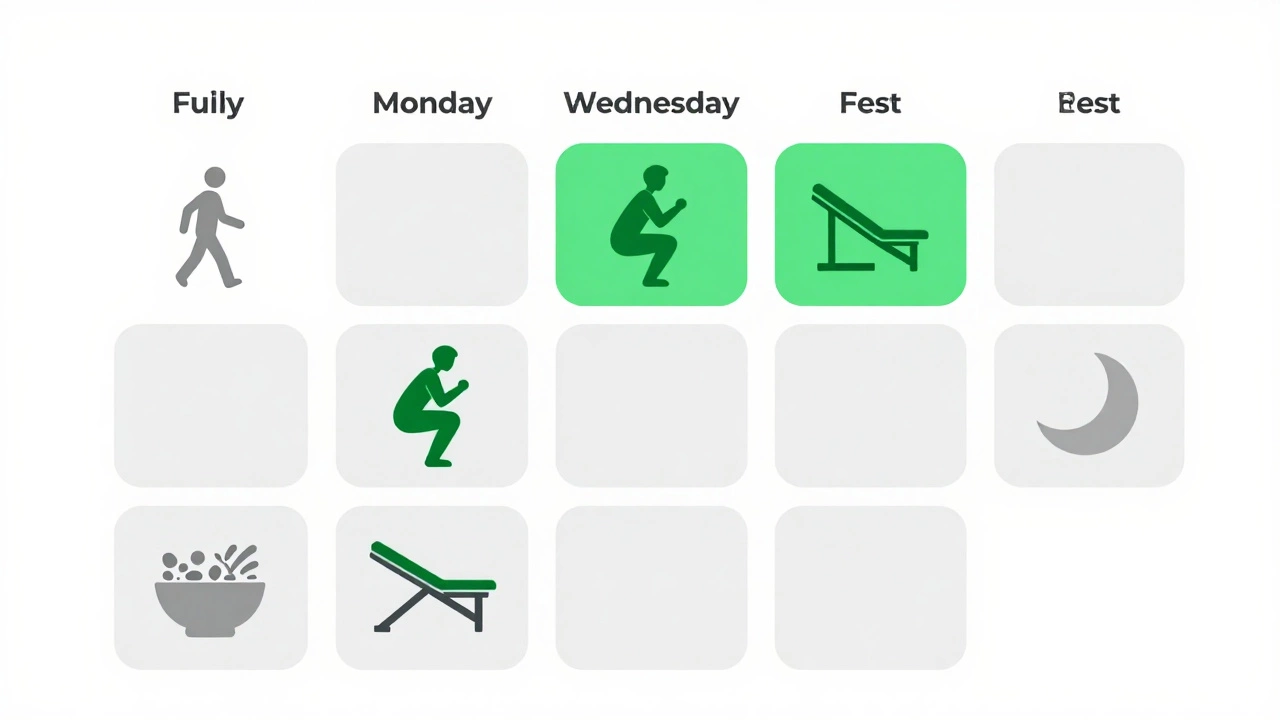
If you choose two days, aim for a split like Monday/Thursday or Tuesday/Friday. This gives you three full days of rest between sessions. If you choose three days, try Monday/Wednesday/Friday. This allows for 48 hours of recovery between each workout while keeping you active throughout the week.
You might see advanced lifters following "bro splits" where they train chest on Monday, back on Tuesday, legs on Wednesday, etc. Do not copy this. As a beginner, you lack the volume capacity to stimulate growth with just one set of exercises per week. A "chest day" might only give your pectorals one chance to adapt before seven days pass. That is inefficient.
A full-body routine ensures that every muscle group gets stimulated multiple times per week. For example, if you squat on Monday, Wednesday, and Friday, your quads and glutes get three chances to adapt. This frequency accelerates strength gains significantly compared to a single leg day.
Additionally, full-body workouts are more time-efficient. You spend less time traveling between machines and more time moving iron. A typical beginner full-body session should last no longer than 45 to 60 minutes. Anything longer usually indicates poor pacing or too much chatting, not more work.
Let’s look at how to actually put this into practice. You don’t need complex programming. You need compound movements-exercises that use multiple joints and muscle groups simultaneously. These give you the most bang for your buck.
| Frequency | Schedule Example | Best For |
|---|---|---|
| 2 Days/Week | Monday & Thursday | Busy professionals, those balancing other sports |
| 3 Days/Week | Monday, Wednesday, Friday | Optimal balance of recovery and stimulus |
| 3 Days/Week (Consecutive) | Tuesday, Wednesday, Thursday | Those who prefer weekends off completely |
Notice that I didn’t suggest training six days a week. While some programs advocate for high-frequency training, they require sophisticated periodization and nutrition strategies that beginners rarely execute correctly. Stick to the 2-3 day model until you have been consistent for at least six months.

Frequency alone won’t build strength. You need progressive overload. This simply means doing a little bit more over time. It doesn’t mean adding 10kg to the bar every week. That’s a recipe for injury. Instead, aim for small, incremental increases.
Here is how you apply progressive overload as a beginner:
Keep a logbook. Whether it’s a notebook or an app, write down what you lifted. If you don’t track it, you can’t improve it. Most beginners guess their previous performance and end up under-loading themselves.
Your body will tell you if you are pushing too hard. Ignoring these signals is the fastest way to quit. Watch out for these red flags:
Rest days are not lazy days. They are productive days. On these days, focus on walking, stretching, or mobility work. Active recovery helps flush out metabolic waste and improves blood flow without stressing the system.
You can have the perfect training frequency, but if you eat poorly and sleep badly, you will stall. Strength training creates a demand for resources. Your body needs protein to repair muscle and carbohydrates to fuel the next session.
Aim for approximately 1.6 to 2.2 grams of protein per kilogram of body weight daily. This is the scientific consensus for maximizing muscle retention and growth. Don’t worry about counting calories obsessively, but ensure every meal has a decent portion of protein. Chicken, fish, eggs, tofu, lentils, and Greek yogurt are great options.
Sleep is where the magic happens. During deep sleep, your body releases growth hormone. Aim for 7 to 9 hours per night. If you are cutting corners here, no amount of gym time will compensate. It’s like trying to fill a bucket with a hole in the bottom.
Eventually, you will plateau. You’ll notice that adding weight becomes harder. Your lifts stay the same for weeks. This is normal. It usually happens around the 6 to 12-month mark. At this point, you might consider increasing your frequency to four days a week.
A common transition is moving from a full-body routine to an upper/lower split. You would train upper body on Monday and Thursday, and lower body on Tuesday and Friday. This allows you to increase volume per muscle group while still providing adequate recovery. But don’t rush this. Master the basics first. Consistency beats complexity every time.
Even with the right frequency, beginners often sabotage their progress. Here are the biggest pitfalls:
Start simple. Commit to two or three days a week. Focus on full-body workouts using compound exercises. Track your progress. Eat enough protein. Sleep well. Listen to your body. If you follow this blueprint, you will see significant strength gains within the first three months. The key is patience. Strength training is a marathon, not a sprint. The people who win are not the ones who train the hardest every day; they are the ones who show up consistently for years.
It is generally not recommended for beginners to strength train every day. Your muscles and central nervous system need 48 hours to recover from intense sessions. Training daily without proper periodization leads to overtraining, increased injury risk, and stalled progress. Stick to 2-3 days per week initially.
For beginners, full-body workouts are superior. They allow you to hit each muscle group 2-3 times per week, which optimizes muscle protein synthesis and neurological adaptation. Split routines (like bro splits) are better suited for advanced lifters who can handle higher volume per session.
Aim for 45 to 60 minutes. This includes a 5-10 minute warm-up, 30-45 minutes of lifting, and a brief cool-down. Longer sessions often indicate inefficiency or excessive rest periods. Quality matters more than quantity.
Focus on compound movements that engage multiple muscle groups. Key exercises include squats, deadlifts, bench presses, overhead presses, bent-over rows, and pull-ups (or lat pulldowns). These provide the most functional strength and efficiency.
Signs of proper recovery include feeling energized for workouts, improving strength numbers, good sleep quality, and absence of joint pain. If you feel chronically fatigued, weak, or experience persistent soreness, you may need more rest days or better nutrition.