Discover your ideal workout duration based on your fitness goals. Research shows consistency matters more than duration - find your perfect time commitment.
Select a goal to see your optimal workout time
How long should you really work out each day if you’re doing it at home? It’s not about squeezing in 90 minutes like you see on social media. It’s about what actually sticks, what fits your life, and what gets results without burning you out. The truth? You don’t need hours. You don’t even need 45 minutes. Most people get better results from 20 to 30 minutes of focused effort than from an hour of half-hearted effort followed by guilt.
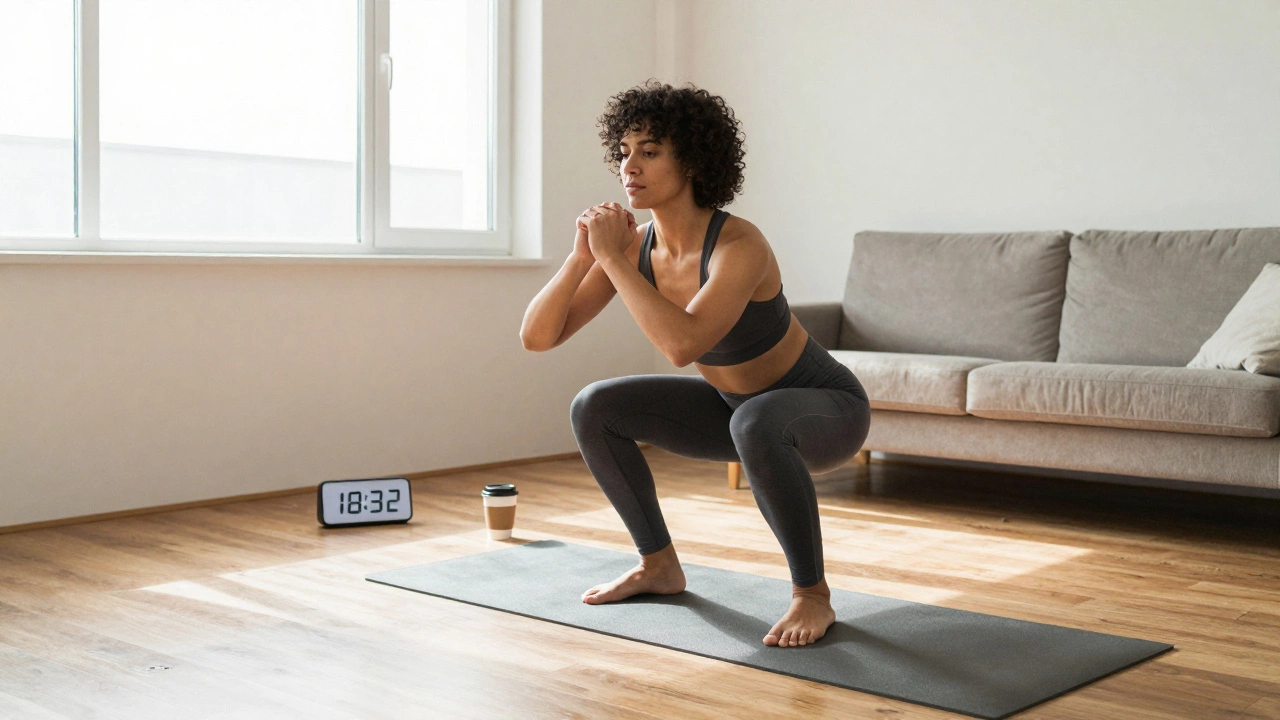
If you’re new to home workouts or just getting back into it, 20 minutes is more than enough. That’s 10 minutes of movement, 10 minutes of recovery. You can do a full-body routine in that time: squats, push-ups, lunges, planks, and a few rounds of jumping jacks or high knees. No equipment needed. No commute. No waiting for a machine to free up.
Research from the American College of Sports Medicine shows that even short bouts of activity - like 10-minute chunks spread through the day - add up. But when you do them back-to-back in one session, your body burns more calories, improves cardiovascular health, and builds strength faster. A 20-minute workout done five days a week beats a 60-minute workout done once a week every time.
Weight loss isn’t just about how long you move - it’s about how hard you move and what you eat. But if you’re focused on fat loss through home workouts, aim for 30 to 40 minutes most days. That means mixing strength moves with bursts of cardio. For example: 5 minutes warm-up, 20 minutes of circuit training (like bodyweight squats, mountain climbers, push-ups, and glute bridges), then 5-10 minutes of brisk walking in place or jumping rope if you have a rope.
One study tracked people doing 30-minute home workouts five days a week for 12 weeks. They lost an average of 4.5 pounds of fat without changing their diet. When they added better eating habits, the fat loss jumped to nearly 10 pounds. So yes, diet matters - but movement is the spark. You don’t need to sweat for an hour. You need to move with intention.
Building muscle doesn’t require hours in the gym. It requires progressive overload - getting stronger over time. At home, you can do that with resistance bands, dumbbells, or just your body. A solid strength session? 30 minutes. Here’s how it breaks down:
Do this three times a week, and you’ll notice your arms getting firmer, your legs stronger, your posture better - all in about four weeks. You don’t need a 90-minute session. You need consistency. Your body adapts to regular stress, not marathon sessions.
High-Intensity Interval Training (HIIT) is great for home workouts because it’s time-efficient. But here’s the mistake people make: they think longer = better. Nope. A 15-minute HIIT session done right is more effective than a 45-minute slog.
Try this: 30 seconds of burpees, 30 seconds of rest. Repeat 8 times. That’s 4 minutes of work. Add 2 minutes of jumping jacks and 2 minutes of mountain climbers, and you’ve got a 10-minute burner. Do it three times a week. You’ll boost your metabolism, improve heart health, and torch calories - all in under 20 minutes total.
Studies from the University of Western Australia found that people doing 15-20 minute HIIT sessions three times a week improved their VO2 max (a measure of cardiovascular fitness) just as much as those doing 45-minute steady-state cardio sessions. Shorter. Harder. Better results.

If your goal is flexibility, stress relief, or recovery, 15 to 20 minutes of yoga or mobility work is ideal. You don’t need to hold poses for an hour. A simple routine - downward dog, child’s pose, pigeon stretch, seated forward fold, and a few deep breaths - done daily, does more for your nervous system than an hour of distracted scrolling.
People in Perth who do 15 minutes of morning yoga before coffee report better sleep, less lower back pain, and improved focus. It’s not about flexibility - it’s about resetting your body. That’s why 15 minutes a day is more valuable than 60 minutes once a week.
There are times when you’ll want to go beyond 30 minutes. If you’re training for a specific goal - like a 10K walk, a home fitness challenge, or building endurance - then 45 to 60 minutes makes sense. But even then, it shouldn’t be daily. Most people benefit from one longer session a week (maybe on Sunday), and the rest of the week stays short and sharp.
Longer workouts also increase injury risk if you’re not properly fueled or rested. If you’re feeling drained, sore, or mentally checked out after a 60-minute session, you’re not training smarter - you’re overdoing it.
Here’s what no one tells you: the most effective workout is the one you do every day. Not the one you do for an hour on Monday and never touch again. People who work out 20 minutes a day, six days a week, outperform those who do 90 minutes once a week by a huge margin.
Think of it like brushing your teeth. You don’t brush for 30 minutes once a week. You do 2 minutes, twice a day. Same principle. Movement is medicine. Small, daily doses build resilience. Big, rare doses just make you sore and discouraged.
Set a timer. Do your 20 minutes. Then move on with your day. No guilt. No pressure. Just movement. That’s how habits form.

Life gets busy. Kids, work, errands - you’re tired. That’s normal. Here’s the fix: 10 minutes counts. Do three sets of 10 squats, 10 push-ups, and 10 glute bridges. Do them in your living room while the kettle boils. Do them before your shower. Do them after you put the kids to bed.
That’s 30 reps of each movement. That’s enough stimulus to keep your muscles active, your circulation moving, and your metabolism humming. You’re not trying to get ripped in a week. You’re trying to stay strong, mobile, and energized over years.
Most fitness apps push you to do 30, 45, or 60 minutes because they want you to stay engaged. But your body doesn’t care about the timer. It cares about recovery, sleep, and stress levels. If you’re exhausted, sore, or sleeping poorly, cut the workout. Do 10 minutes of stretching instead. Or take a rest day.
Rest isn’t failure. It’s part of the process. Your muscles grow when you rest, not when you’re sweating. Pushing through fatigue leads to burnout - not results.
Here’s your simple, no-nonsense answer: aim for 20 to 30 minutes of movement most days of the week. Mix it up - some days strength, some days cardio, some days yoga. Skip a day if you need to. Don’t try to make up for it. Just show up again tomorrow.
You don’t need a fancy home gym. You don’t need to sweat for an hour. You just need to move consistently. That’s how people in Perth, and everywhere else, stay fit without burning out. That’s how real results happen - slowly, steadily, and without drama.