Source: Chicken, eggs, tofu, lentils, Greek yogurt.
| Exercise | Sets | Reps/Time | Rest |
|---|
Enter your details to generate your personalized strength training plan.
There is a myth that you need a gym membership, a rack of heavy iron, and a spotter to build real strength. It is simply not true. You can build significant muscle and power in your living room with zero equipment or just a few basic tools. The barrier to entry for strength training has never been lower, yet many people still feel stuck because they do not know where to start.
If you have decided to begin your fitness journey from home, you are making a smart move. It saves time, cuts costs, and eliminates the intimidation factor of crowded gyms. But how do you actually structure this? Do you just do push-ups until you drop? Not exactly. To get results without getting injured, you need a plan that respects the biology of your muscles.
Before you lift a single weight or do a single squat, you need to understand two non-negotiable rules: progressive overload and consistency. These are the engines that drive physical change.
Progressive overload means gradually increasing the demand placed on your musculoskeletal system over time. In a commercial gym, this usually means adding more plates to the bar. At home, it looks different. If you are doing bodyweight squats, you cannot add weight easily. So, you must make the movement harder by slowing down the tempo, increasing the range of motion, or adding more repetitions. If you do ten push-ups today, your goal next week should be twelve, or perhaps ten slower, more controlled push-ups. Without this gradual increase, your body adapts quickly and stops changing.
Consistency beats intensity every time. Doing a perfect workout once a month will yield nothing. Doing a moderate workout three times a week for six months will transform your physique. Aim for frequency first. Build the habit before you worry about hitting personal records.
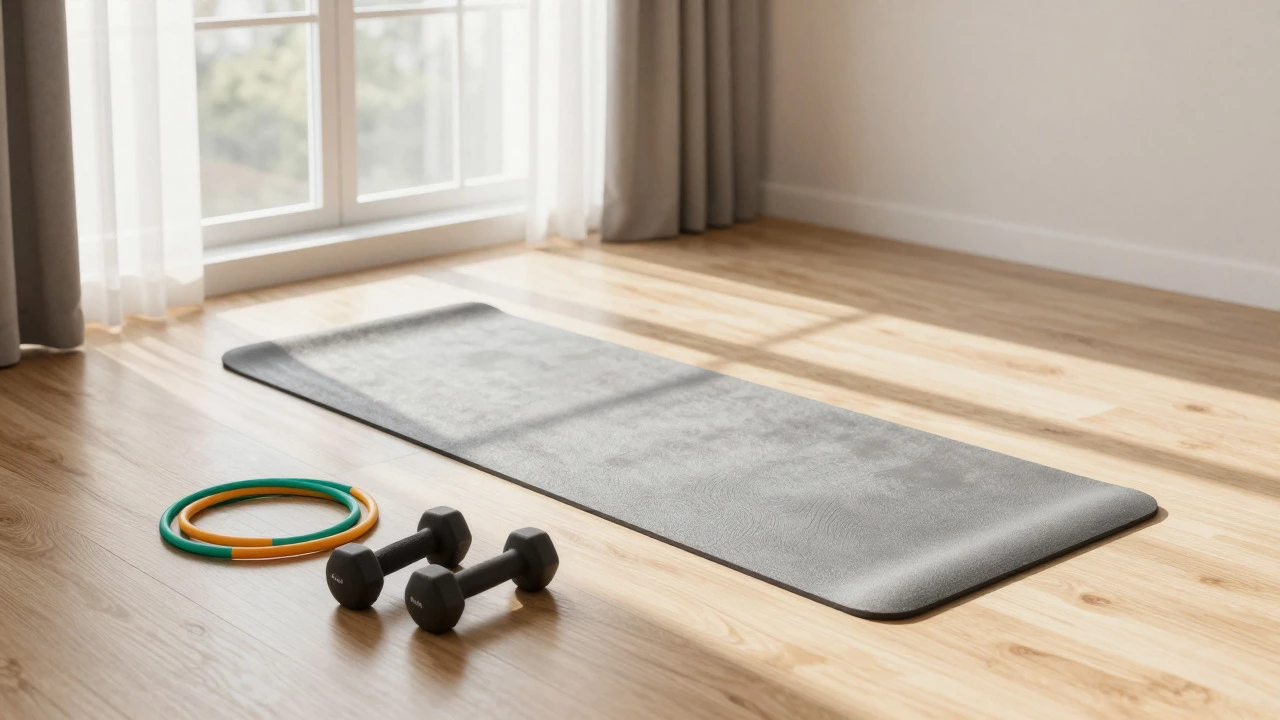
You do not need a dedicated basement or garage. A cleared corner of your bedroom or living room works fine. However, safety and comfort matter. Ensure you have enough space to extend your arms fully without hitting furniture. Invest in a decent quality exercise mat. Cheap mats slip and compress too much, which ruins your balance during lunges or planks.
Regarding equipment, start with nothing. Your body weight is sufficient for the first four to eight weeks. Once you master bodyweight movements, consider buying adjustable dumbbells or a set of resistance bands. Resistance bands are particularly useful for home users because they are cheap, take up no space, and provide variable tension throughout the movement. They mimic the feel of cable machines found in gyms.
To build a complete foundation, you need to train all major movement patterns. You do not need fifty different exercises. Five core movements cover almost everything. Focus on mastering these before adding complexity.

Do not overcomplicate the schedule. For beginners, a full-body workout performed three times a week is optimal. This allows for adequate recovery between sessions. Train on Monday, Wednesday, and Friday, for example. Rest days are when your muscles actually grow and repair.
Here is a simple template to follow for your first eight weeks:
| Exercise | Sets | Repetitions | Rest Time |
|---|---|---|---|
| Bodyweight Squats | 3 | 10-15 | 60 seconds |
| Push-Ups (or Incline) | 3 | 8-12 | 60 seconds |
| Resistance Band Rows | 3 | 10-15 | 60 seconds |
| Lunges (each leg) | 2 | 8-10 | 45 seconds |
| Plank Hold | 3 | 30-45 seconds | 45 seconds |
Perform this routine in order. If you finish the last rep of a set and could have done five more easily, the weight or leverage was too light. Make the next session slightly harder. If you fail before the minimum reps, regress the exercise (e.g., go back to incline push-ups).
Injury is the number one reason home trainers quit. Most injuries come from ego lifting or poor mechanics. Since you are alone, you must be honest with yourself. Film your sets with your phone. Watch the playback. Does your back round during the deadlift? Do your knees cave in during squats?
Focus on "mind-muscle connection." This means consciously thinking about the muscle working. When you do a row, think about pulling with your elbows, not your hands. When you squat, think about driving through your heels. This neural engagement recruits more muscle fibers and improves efficiency.
Breathing is also critical. Exhale during the exertion phase (pushing or pulling) and inhale during the return phase. Never hold your breath, as this spikes blood pressure unnecessarily.

You cannot out-train a bad diet. Strength training stimulates muscle growth, but food provides the building blocks. Ensure you are eating enough protein. A general guideline is 0.7 to 1 gram of protein per pound of body weight daily. Chicken, eggs, tofu, lentils, and Greek yogurt are accessible options.
Hydration affects performance significantly. Even mild dehydration reduces strength output. Drink water throughout the day, not just during the workout. Sleep is the final piece of the puzzle. Aim for seven to nine hours of quality sleep. Growth hormone is released during deep sleep, facilitating tissue repair.
Many beginners obsess over the bathroom scale. While weight loss might be a goal, strength training is about capability. Track your performance metrics instead. Use a notebook or a simple app to log your workouts.
If you did 10 push-ups last week and 12 this week, you got stronger. If you held a plank for 30 seconds previously and 40 seconds now, your core improved. These are tangible proofs of progress. Take monthly photos in consistent lighting. Visual changes often lag behind strength gains, so patience is key.
Avoid the "weekend warrior" syndrome. Cramming all exercise into Saturday and Sunday leads to burnout and injury. Spread your training out. Also, do not neglect mobility. Tight hips limit squat depth. Tight shoulders limit overhead press range. Spend five minutes after each workout stretching the muscles you trained.
Another mistake is copying advanced internet workouts. Just because someone online does pistol squats does not mean you should try them on day one. Respect the progression. Master the basics first. The fundamentals never go out of style.
Most people notice increased strength and better endurance within 4 to 6 weeks. Visible muscle definition typically takes 8 to 12 weeks of consistent training and proper nutrition. Neural adaptations (your brain learning to recruit muscles) happen faster than physical muscle growth, so you will feel stronger before you look significantly different.
Yes, absolutely. Bodyweight exercises can build significant muscle if you apply progressive overload. This means making exercises harder over time by increasing reps, slowing down the tempo, reducing rest periods, or using unilateral variations (like single-leg squats). Once bodyweight becomes too easy, adding resistance bands or dumbbells accelerates growth.
For beginners, 3 days per week is ideal. This allows for full-body workouts with adequate recovery time between sessions. As you become more advanced, you might split your routine into upper/lower body days and train 4 to 5 days a week, but consistency with 3 days is better than inconsistency with 5.
The best time is whenever you can consistently stick to it. Morning workouts can boost metabolism and ensure you get it done before daily distractions arise. Evening workouts may allow for better performance as your body temperature is higher and muscles are warmer. Choose a time that fits your schedule and energy levels.
Not necessarily. By choosing exercises that allow you to bail safely (like dropping dumbbells or stopping a push-up), you minimize risk. Avoid maximal lifts where failure means being crushed under weight. Stick to sub-maximal loads where you can always complete the rep with good form, even if it requires slowing down.