Answer these questions to determine which training style aligns best with your current needs.
Complete the quiz to see if HIIT or Weights is better for you.
--
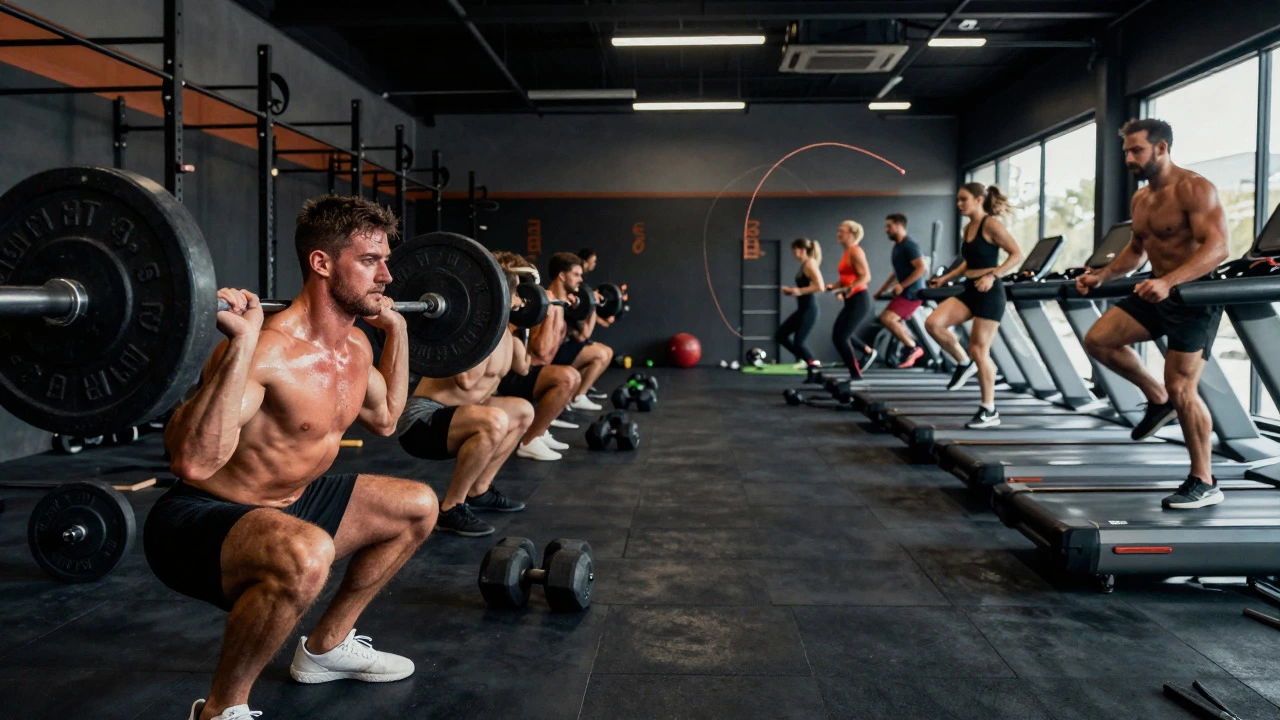
Walk into any gym in Perth on a Tuesday evening, and you’ll see the same split. One corner is packed with people lifting heavy iron, grunting through squats and deadlifts. The other side is filled with folks jumping rope, doing burpees, and sprinting on treadmills. Both groups want the same thing: a better body. But they are using completely different tools to get there.
You’ve probably heard the debate. High-Intensity Interval Training (HIIT) burns more calories in less time. Weightlifting builds long-term metabolism and shape. So, which one is actually better? The short answer is that neither is universally "better." It depends entirely on what your body needs right now. If you pick the wrong one, you might hit a plateau or worse, get injured.
To understand why this debate exists, we have to look at how your body spends energy. Many people think fat loss is just about how many calories you burn during the workout. That’s a trap.
When you do HIIT is a form of exercise that alternates short bursts of intense anaerobic exercise with periods of rest or low-intensity recovery. You create what scientists call Excess Post-exercise Oxygen Consumption (EPOC). Basically, your body stays in a state of high oxygen demand after the workout ends, burning extra calories as it tries to return to normal. This effect can last up to 48 hours, but the actual number of extra calories burned is often overstated. We’re talking maybe 6-15% of the total calories burned during the session.
On the other hand, Resistance Training is exercise involving the use of resistance to induce muscular contraction, which builds the strength, anaerobic endurance, and size of skeletal muscles. doesn’t give you a huge immediate EPOC spike. However, muscle tissue is metabolically expensive. Your body has to work harder just to keep that muscle alive while you sleep, eat, and sit on the couch. The more muscle you carry, the higher your Total Daily Energy Expenditure (TDEE) becomes, even when you aren’t moving.
Think of it this way: HIIT is like taking out a small loan against your future energy stores. Weightlifting is like buying a house that generates rent every month. One gives you a quick cash injection; the other builds long-term wealth.
Here is where the visual difference comes in. If you lose weight through diet and HIIT alone, you will likely lose both fat and muscle. This leads to the dreaded "skinny fat" look-where the scale goes down, but your arms and legs look soft and undefined.
Weightlifting signals your body to hold onto muscle tissue while stripping away fat. This is crucial because muscle provides structure. Without it, losing 10 kilograms might make you look smaller, but not necessarily tighter or stronger. Studies consistently show that resistance training preserves lean mass during caloric deficits far better than cardio does.
Consider two people who both drop from 90kg to 80kg. Person A did only HIIT. They lost 5kg of fat and 5kg of muscle. Their metabolism slowed down significantly because they have less engine to run. Person B lifted weights. They lost 7kg of fat and only 3kg of muscle. Person B looks athletic, has a faster resting metabolism, and is less likely to regain the weight later.
We often forget that fitness isn't just about looking good in summer; it's about being able to move well when we're 60. HIIT involves repetitive high-impact movements. Jumping, sprinting, and box jumps place significant stress on your knees, ankles, and hips. If you have existing joint issues, or if you live in a hot climate like Perth where heat exhaustion can affect performance, high-impact HIIT can be risky.
Weightlifting, when done with proper form, strengthens the connective tissues around your joints. It increases bone mineral density, which is critical for preventing osteoporosis later in life. While HIIT improves cardiovascular health, it does very little for bone strength. If longevity is your goal, loading your skeleton with progressive resistance is non-negotiable.
Let’s be real. Most of us are busy. HIIT wins hands down on time efficiency. A solid HIIT session can be effective in 20 minutes. You don’t need a gym membership; you can do it in your living room. This accessibility is why HIIT apps and programs exploded in popularity over the last decade.
Weightlifting requires more setup. You need to warm up properly, select weights, perform sets, and cool down. A full-body strength session usually takes 45 to 60 minutes. Plus, you generally need access to a gym or home equipment. If your schedule is chaotic and you can only spare 20 minutes three times a week, HIIT is the pragmatic choice. Doing something is always better than doing nothing.
So, which should you pick? Here is a practical decision tree based on your goals:
The ideal approach for most adults is periodization. Spend 70% of your energy on strength training to build the foundation, and use 30% for HIIT or moderate cardio to support heart health and calorie expenditure. Don’t let the internet wars fool you. Your body thrives on variety, not dogma.
| Feature | HIIT Workouts | Weight Training |
|---|---|---|
| Primary Benefit | Cardiovascular endurance & quick calorie burn | Muscle growth & bone density |
| Metabolic Impact | Short-term EPOC effect | Long-term increase in basal metabolic rate |
| Injury Risk | Higher due to impact and fatigue | Lower if form is correct |
| Equipment Needed | Minimal to none | Dumbbells, barbells, or machines |
| Best For | Busy schedules, athletes needing stamina | Body recomposition, aging populations |
Yes, but order matters. Always lift weights first when you are fresh to ensure proper form and maximum force output. Follow up with HIIT for 15-20 minutes. If you do HIIT first, you will be too fatigued to lift safely or effectively.
No exercise targets specific areas of fat loss. Spot reduction is a myth. However, HIIT is effective at reducing overall body fat percentage, which will eventually include belly fat. Combining it with a slight caloric deficit is key.
For most people, especially women, gaining significant bulk is difficult. It requires a specific diet surplus and years of dedicated training. Lifting weights will likely make you look "toned" or "firm" rather than bulky, as it replaces soft tissue with dense muscle.
Because HIIT places high stress on the central nervous system and joints, 2 to 3 sessions per week is sufficient for most people. More than that can lead to overtraining, burnout, or injury without providing additional benefits.
Beginners often benefit more from learning basic movement patterns with light weights. Proper form in squats, hinges, and pushes creates a foundation that makes all future exercise safer and more effective. Start with weights, then add HIIT once your joints are conditioned.